Last updated: September 10, 2026
Key Takeaways
- Month 1 affects month 2, month 2 affects month 3, and so on.
- If the annual rate is 6%, the monthly rate is 0.5% in decimal form, or 0.06 ÷ 12.
- A 15-year mortgage has 180 .
- Multiply years by 12, so 25 years becomes 300 months and 30 years becomes 360 months.
Table of Contents

- Who this is for, and what you need before you start
- What does mortgage amortization mean month by month?
- How do you calculate mortgage amortization by month?
- What should you check before trusting the schedule?
- When does the standard monthly method not apply?
- What mistakes do people make most often?
- How much does mortgage amortization by month change your payment?
A mortgage schedule can look tidy on paper and still hide a lot of pain. Mortgage amortization by month is the line-by-line breakdown that shows how each payment is split between interest and principal, and how the balance shrinks over time. Want to check a lender’s figures, see why the early years feel interest-heavy, or test an extra payment? This is the math you need. It is information, not financial advice; mortgage rules, tax treatment, and payment rules vary by country and lender, so a qualified adviser, loan officer, or tax professional should be consulted for your own situation. For background, see the CFPB on mortgage basics and the IRS on home mortgage interest.
Who this is for, and what you need before you start
This is for a borrower who already knows the loan amount, the interest rate, the repayment term, and the payment frequency, and wants the month-by-month breakdown rather than the one-line payment figure. In practice, I am assuming a standard fully amortizing mortgage — the kind designed to reach zero by the end of the term through scheduled payments. A 30-year fixed-rate loan in the United States, a 25-year repayment mortgage in the UK, or any similar installment loan fits this method.
Not every mortgage belongs in that box. Interest-only periods, balloon payments at the end, payment holidays, frequent variable-rate resets, and negative-amortization features all change the shape of the schedule. You can still work month by month, but the setup shifts, and the lender’s disclosure or an adviser should steer the calculation. Miss one feature, and the spreadsheet can go sideways by month 18. Ugly, really.
I also assume you can read basic loan terms: principal is the amount borrowed, interest rate is the annual cost of borrowing, and amortization is the process of paying the balance down over time. If your lender quotes a nominal annual rate, make sure you know whether the loan compounds monthly or uses a different convention. The monthly rate is the annual rate divided by 12 only when the loan uses simple monthly compounding in the standard way; some markets and contracts use other conventions.
The method below works best when you want a month-by-month amortization schedule for the first payment, the entire term, or a specific segment such as months 1 through 60. It can also help you spot a lender error on a statement when the principal balance does not look right after a 1-month payment cycle.
What does mortgage amortization mean month by month?

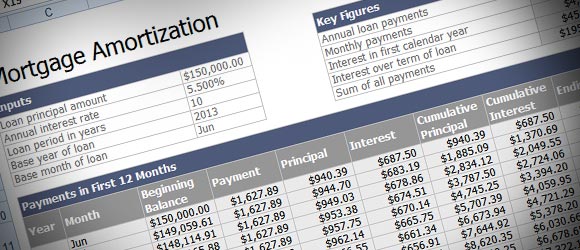
Mortgage amortization month by month means each payment is split into two pieces: interest for that month and principal reduction. Interest is the charge for using the lender’s money. Principal is the part that lowers the loan balance. Early on, the interest slice is bigger because the outstanding balance is largest. Later, the principal slice grows because there is less balance left to charge interest on.
Three numbers drive the monthly schedule: the original loan balance, the monthly interest rate, and the fixed monthly payment if the loan is fully amortizing. Once those are set, every later month follows the same pattern. The remaining balance after each payment becomes the starting balance for the next month. That is the core loop.
A generic explanation often skips the practical part: mortgage amortization is not just a formula, it is a sequence. Month 1 affects month 2, month 2 affects month 3, and so on. If the payment is even a little off, the difference snowballs across 12 months, 120 months, or 360 months. So you need a step-by-step method, not just a final payment number.
Here is the standard structure for a fixed-rate loan with monthly payments:
- Convert the annual interest rate to a monthly rate. If the annual rate is 6%, the monthly rate is 0.5% in decimal form, or 0.06 ÷ 12.
- Calculate the fixed monthly payment using the mortgage payment formula.
- Compute the interest due for month 1 by multiplying the opening balance by the monthly rate.
- Subtract that interest from the payment to find the principal paid.
- Subtract the principal from the opening balance to get the new balance.
- Repeat the process for month 2 using the new balance.
- Continue until the balance reaches zero, adjusting the last payment if needed for rounding.
That last point matters because cents round. If your spreadsheet shows a 2-cent balance in the final row, the problem is usually rounding logic, not the mortgage itself. A lender may round each month’s interest to the nearest cent, while a spreadsheet can carry more precision internally. The schedule should match the lender’s method as closely as possible if you are trying to reconcile statements.
How do you calculate mortgage amortization by month?
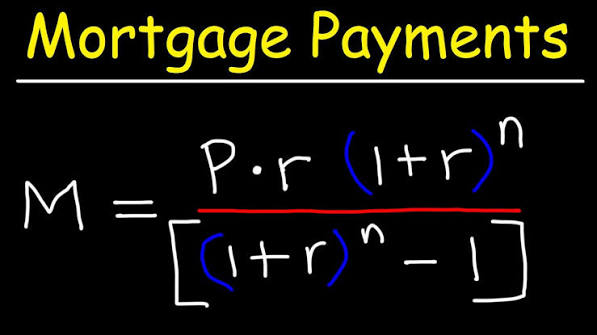
Build the month-by-month loop: interest, principal, new balance, repeat. The formula for the fixed monthly payment on a standard fully amortizing loan is commonly written as:
M = P × r ÷ [1 – (1 + r)^(-n)]
Where:
– M = monthly payment
– P = principal borrowed
– r = monthly interest rate
– n = total number of monthly payments
For example, a 30-year mortgage has 360 monthly payments. A 15-year mortgage has 180. Those are not universal rules for all countries, but they are standard term lengths in many markets.
| Term | Payments | Typical use | Monthly payment size |
|---|---|---|---|
| 15 years | 180 | Faster payoff | Higher |
| 25 years | 300 | Common repayment term | Middle |
| 30 years | 360 | Common fixed-rate term | Lower |
- Write down the original loan amount exactly. Use the starting principal, not the home price, and not the amount after fees. Verify whether your lender financed closing costs or mortgage insurance into the balance. If you use the wrong starting figure, every month in the schedule will be off.
- Convert the annual interest rate into a monthly decimal rate. Divide the annual nominal rate by 12 only if the loan compounds monthly in the standard way. For a 7.2% annual rate, the monthly rate is 0.072 ÷ 12 = 0.006. Verify the lender’s compounding convention. If the contract uses a different basis, the monthly interest line will not match.
- Count the total number of scheduled payments. Multiply years by 12, so 25 years becomes 300 months and 30 years becomes 360 months. Verify whether the first payment is due one month after closing or after a longer deferment. If the payment count is wrong by even 1 month, the monthly payment formula changes.
- Calculate the fixed monthly payment. Plug principal, monthly rate, and payment count into the formula. Verify that the payment is high enough to cover at least that month’s interest. If the payment is too low, the balance will rise instead of fall, which is negative amortization.
- Find month 1 interest. Multiply the opening balance by the monthly rate. Verify the result against the lender’s statement if you have one. If the lender rounds differently, you may see a 1-cent or 2-cent difference, which is usually a rounding issue rather than a wrong formula.
- Find month 1 principal. Subtract month 1 interest from the payment. Verify that principal is positive. If principal is zero or negative on a standard fixed-rate loan, the payment is not sufficient or the rate assumption is wrong.
- Find the new balance after month 1. Subtract principal from the opening balance. Verify that the balance is lower than the previous balance. If it is not, the schedule is broken or the loan has an unusual structure.
- Repeat the same three lines for month 2 and beyond. Use the prior month’s ending balance as the new opening balance. Verify the interest portion declines over time and the principal portion rises over time on a fixed-rate loan. If the pattern is flat or inverted without an intentional reason, recheck the rate, payment, and rounding method.
A simple worked structure looks like this:
- Month 1 opening balance: loan amount
- Month 1 interest: opening balance × monthly rate
- Month 1 principal: monthly payment – month 1 interest
- Month 1 ending balance: opening balance – principal
- Month 2 opening balance: month 1 ending balance
Keep going until the ending balance reaches zero. If the final balance is not zero because of rounding, the last payment is usually adjusted by a small amount. That adjustment is normal. A balance that is off by more than a few cents means one of the inputs is wrong or the lender uses a different payment convention.
A practical note: if you are doing this in a spreadsheet, keep at least 4 to 6 decimal places for the rate and balance calculations, then round only the displayed payment lines. Rounding too early is a common reason schedules drift by the end of a 15-year or 30-year term.
What should you check before trusting the schedule?
Check the loan type, rate type, payment timing, and rounding rule before you trust any monthly amortization table. Those four items decide whether the math is the right math at all.
First, confirm whether the loan is fixed-rate or adjustable-rate. A fixed-rate mortgage keeps the interest rate constant across the schedule, so the monthly payment usually stays constant too. An adjustable-rate mortgage, or ARM, resets on a schedule such as every 12 months, so one flat month-by-month calculation only covers the current rate period. If your loan resets after 60 months, a 360-month single-rate table is incomplete.
Second, check whether payments begin immediately or after a grace period. If the first payment is delayed by 30 days, the first month’s interest still accrues, but the schedule timing changes. That affects the first line of the amortization table and may change the amount of interest shown on the first statement.
Third, confirm how your lender handles rounding. Some lenders round each month’s interest to the nearest cent. Others keep internal precision and round only on the statement. If you are trying to match a mortgage statement exactly and your spreadsheet is off by a cent or two, that is often the reason.
Fourth, check for extra monthly charges that are not part of amortization. Property tax, homeowners insurance, private mortgage insurance, and HOA dues are not principal or interest, so they do not belong inside the amortization formula. They matter to your monthly cash flow, but not to the amortization balance. For tax and insurance treatment, consult a tax professional or lender and follow the applicable IRS or local guidance.
A detailed schedule is most useful when you know which line is which. Honestly, I would trust the amortization math more than a generic “monthly payment” quote if the inputs are clear. I would trust it less if the loan has a teaser rate, interest-only stage, or any rule that lets principal stay unchanged for a time.
When does the standard monthly method not apply?
The standard monthly method does not apply when the loan has features that interrupt the normal principal-and-interest pattern. In those cases, you need the lender’s actual payment rules or a qualified adviser to map the schedule correctly.
Interest-only period: The payment covers interest only for a set time, often 5 or 10 years, so principal does not fall during that window — You need two schedules: one for the interest-only phase and one for the amortizing phase.
Adjustable rate resets: The rate changes on a fixed date or index trigger, such as every 12 months — Recalculate the payment at each reset using the remaining balance and remaining term.
Balloon payment due at maturity: The monthly payment is not enough to pay the balance to zero by the end date — The standard amortization formula will understate the final amount due, so use the contract’s balloon terms.
Negative amortization allowed: The payment can be less than interest due, causing the balance to rise — The usual “balance goes down every month” assumption fails, and the schedule must track unpaid interest separately.
Extra principal payments are made irregularly: A one-time $500 or $2,000 principal payment changes every later month — Recalculate the next month from the lower balance, or the table will drift from reality.
Loan modifications or forbearance: The lender changes payment terms after hardship or refinancing — The original amortization schedule is no longer the right reference point, and the modified contract controls.
In every one of those cases, a 360-row table can look neat and still be wrong. That is why a mortgage with unusual features should not be treated like a plain fixed-rate installment loan without checking the note or speaking with a qualified mortgage professional. Need the exact payment path? Follow the note, the disclosure, or the servicer’s statement. For consumer guidance, see the CFPB mortgage resources and your lender’s contract.
What mistakes do people make most often?
People usually make five mistakes, and each one changes the balance or the payment in a predictable way.
-
Using the home price instead of the loan amount. This inflates the payment and every month’s interest line. The correct alternative is to use the borrowed principal after down payment and financed costs.
-
Dividing the annual rate by 12 when the loan uses a different compounding method. This makes the monthly rate slightly or seriously wrong depending on the contract. The correct alternative is to confirm the lender’s rate convention before calculating.
-
Forgetting that the payment count is in months, not years. A 20-year loan is 240 payments, not 20. The consequence is a bad payment figure and a broken amortization curve. The correct alternative is to multiply the term in years by 12.
-
Rounding too early in a spreadsheet. If you round interest or balance before the final column, the schedule can drift by several cents or more over 180 or 360 months. The correct alternative is to keep full precision in calculations and round only for display.
-
Treating taxes, insurance, and PMI as part of amortization. Those costs affect the monthly bill, but they do not reduce principal. The consequence is confusion about why the loan balance is not falling as fast as expected. The correct alternative is to separate escrow and insurance from principal-and-interest math, and if needed, check the treatment with a mortgage professional or tax adviser.
-
Assuming every month behaves the same on an ARM or a special mortgage. That can produce a schedule that looks neat and is wrong after the first reset or special period. The correct alternative is to recalculate when the contract changes.
How much does mortgage amortization by month change your payment?
Mortgage amortization by month changes the payment more than most borrowers expect because the term length and rate both affect the balance path. A shorter term usually raises the monthly payment but reduces total interest paid. A longer term lowers the monthly payment but keeps the loan outstanding for more months. That is why comparing monthly amortization schedules is useful before choosing a loan.
For a standard fixed-rate mortgage, the monthly payment is fixed, but the split between interest and principal is not. In the early months, more of the payment goes to interest. In later months, more goes to principal. That pattern is what makes the mortgage amortization table so useful for planning prepayments, refinancing, or early payoff.
It also helps explain why extra principal payments matter. Even small additional amounts can shorten the term and reduce total interest because they reduce the balance before future interest is charged. If you want to see the effect clearly, build a second monthly amortization schedule with the extra payment included and compare the ending balance month by month.
For legal and tax questions, the monthly amortization schedule is only part of the picture. Lenders, tax authorities, and consumer rules can change how a payment is applied or disclosed. If the loan is unusual, the contract and a qualified professional should take priority over a generic formula.